Tag: SCS

  • Neuromodulation Panel

    Neuromodulation Panel

    [vc_row css=”.vc_custom_1517939115140{padding-right: 20px !important;padding-left: 20px !important;background-color: #fbfbfb !important;}”][vc_column][vc_column_text]Published on September , 2020

    An esteemed panel of neuromodulation experts addresses audience questions about the theory and practice of spinal cord and dorsal root ganglion stimulation. They discuss how to manage opioid use in neuromodulation patients, the difference between randomized controlled trials and retrospective trials, the role for “big data” in protocol development and insurance reimbursement, how to choose between electrical stimulation or intrathecal drug delivery, and how to identify candidates for SCS therapy.

    [/vc_column_text][/vc_column][/vc_row][vc_row][vc_column][vc_column_text css=”.vc_custom_1488298613118{margin-top: -20px !important;}”]


    [/vc_column_text][/vc_column][/vc_row]

  • New Targets in Neuromodulation

    New Targets in Neuromodulation

    [vc_row css=”.vc_custom_1517939115140{padding-right: 20px !important;padding-left: 20px !important;background-color: #fbfbfb !important;}”][vc_column][vc_column_text]Published on August 7, 2020

    Dr. Kenneth Chapman discusses new targets for neuromodulation in pain control protocols. After a brief description of recent device innovations, he elaborates on current data from studies on vagal nerve stimulation, sacral nerve root stimulation, and dorsal root ganglion (DRG) stimulation. Dr. Chapman then introduces some of his own work targeting the T12 DRG with low frequency stimulation in severe low back pain patients and concludes with a potential mechanism of action.

    [/vc_column_text][/vc_column][/vc_row][vc_row][vc_column][vc_column_text css=”.vc_custom_1488298613118{margin-top: -20px !important;}”]


    [/vc_column_text][/vc_column][/vc_row]
  • Concepts in Neuromodulation

    Concepts in Neuromodulation

    [vc_row css=”.vc_custom_1517939115140{padding-right: 20px !important;padding-left: 20px !important;background-color: #fbfbfb !important;}”][vc_column][vc_column_text]Published on July 2, 2020

    Dr. Kenneth B. Chapman provides a comprehensive overview of concepts in neuromodulation and spinal cord stimulation. After a brief review of nerve fibers and neural processing, Dr. Chapman describes tonic, burst, high frequency, and high-density waveforms and their currently accepted modes of action. He goes on to discuss recently published data on the different types of stimulation and whether paresthesia is required for effective pain relief through spinal cord stimulation efficacy.

    [/vc_column_text][/vc_column][/vc_row][vc_row][vc_column][vc_column_text css=”.vc_custom_1488298613118{margin-top: -20px !important;}”]


    [/vc_column_text][/vc_column][/vc_row]
  • The Evolution for the Treatment of Cancer Pain

    The Evolution for the Treatment of Cancer Pain

    [vc_row css=”.vc_custom_1517939115140{padding-right: 20px !important;padding-left: 20px !important;background-color: #fbfbfb !important;}”][vc_column][vc_column_text]Published on April 13, 2020

    Dr. Amitabh Gulati talks with WIP attendees about the innovations in the treatment of cancer. Dr. Gulati describes that through a oncologic approach to pain, new strategies for treatment emerge. He talks about the desire to turn the body’s immune system into a cancer warrior. Amino acid introduction into the cancer patient’s regimine turns on the body’s immune system. He reminds pain physicians that cancer pain is entirely unique in the medical world and why it is important to understand that pain. He also highlights the increasing use of ultrasound to find pain and the introduction of neuromodulation to treat it.

    [/vc_column_text][/vc_column][/vc_row][vc_row][vc_column][vc_column_text css=”.vc_custom_1488298613118{margin-top: -20px !important;}”]


    [/vc_column_text][/vc_column][/vc_row]
  • Closed Loop Spinal Cord Stimulation

    Closed Loop Spinal Cord Stimulation

    [vc_row css=”.vc_custom_1517939115140{padding-right: 20px !important;padding-left: 20px !important;background-color: #fbfbfb !important;}”][vc_column][vc_column_text]Published on March 30, 2020
    Dr. Tim Deer introduces closed-loop spinal cord stimulation to a group of ASIPP Physicians in Las Vegas. He explains the advantages of closed-loop technology vs traditional SCS. Dr. Deer explains how the closed-loop device maintains an amplitude within the therapeutic window far more than open-loop devices. Dr. Deer refers to the “Evoke Study” as a guidepost for the new technology, describing the setup and execution of the double blind study.[/vc_column_text][/vc_column][/vc_row][vc_row][vc_column][vc_column_text css=”.vc_custom_1488298613118{margin-top: -20px !important;}”]


    [/vc_column_text][/vc_column][/vc_row]
  • DRG Stimulation for Low Back Pain

    DRG Stimulation for Low Back Pain

    [vc_row css=”.vc_custom_1517939115140{padding-right: 20px !important;padding-left: 20px !important;background-color: #fbfbfb !important;}”][vc_column][vc_column_text]Published on January 13, 2020
    Dr. Ken Chapman talks about the great success he has seen with the use of dorsal root ganglion stimulation, not only in pain reduction, but also with overall quality of life. He discusses the benefits of the treatment, and how it is superior to dorsal column stimulation. Several of his patients explain how their lives have improved as a result of Dr. Chapman’s effort at Spine Pain Institute of New York.[/vc_column_text][/vc_column][/vc_row][vc_row][vc_column][vc_column_text css=”.vc_custom_1488298613118{margin-top: -20px !important;}”]


    [/vc_column_text][/vc_column][/vc_row]
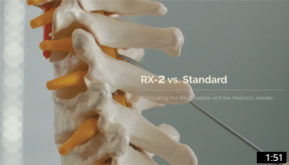
  • RX-2 vs Standard

    RX-2 vs Standard

    [vc_row css=”.vc_custom_1517939115140{padding-right: 20px !important;padding-left: 20px !important;background-color: #fbfbfb !important;}”][vc_column][vc_column_text]Published on February 15, 2017

    Dr. Racz compares the use of a standard introducer needle to the RX-2 Coude needle for inserting spinal cord simulators. The standard needle is similar to that of a Tuohy and has a curve in the tip. This exposed cutting edge can lead to accidental advancement of the SCS into the subdural space. This danger is averted by using the atraumatic stylet with the RX-2 Coude.

    [/vc_column_text][/vc_column][/vc_row]

  • Spinal Cord Stimulation: The Benefits of Conventional vs. High Frequency

    Spinal Cord Stimulation: The Benefits of Conventional vs. High Frequency

    [vc_row css=”.vc_custom_1517939115140{padding-right: 20px !important;padding-left: 20px !important;background-color: #fbfbfb !important;}”][vc_column][vc_column_text]Published on May 18, 2014

    Dr. Harold Cordner talks about spinal cord stimulation and newer technologies, such as conventional and high frequency stimulation.

    [/vc_column_text][/vc_column][/vc_row]