Tag: scarring triangle

  • Gabor Racz – Scarring Triangle

    Gabor Racz – Scarring Triangle

    [vc_row css=”.vc_custom_1517939115140{padding-right: 20px !important;padding-left: 20px !important;background-color: #fbfbfb !important;}”][vc_column][vc_column_text]Published on November 12, 2021

    Dr. Gabor Racz first describes the scarring triangle as a concept. It is scar tissue that is located in-between the L5 dorsal root ganglion (DRG) and the S1 nerve root and above the L5-S1 disc. The scarring triangle poses a problem for catheters and other procedures such as spinal fusions. A case study in pain is discussed, as are other examples of the scarring triangle.

    [/vc_column_text][/vc_column][/vc_row][vc_row][vc_column][vc_column_text css=”.vc_custom_1488298613118{margin-top: -20px !important;}”]


    [/vc_column_text][/vc_column][/vc_row]
  • Scarring Triangle Procedure

    Scarring Triangle Procedure

    [vc_row css=”.vc_custom_1517944580596{padding-right: 20px !important;padding-left: 20px !important;background-color: #fbfbfb !important;}”][vc_column width=”3/4″][vc_column_text]

    Published on June 6, 2017
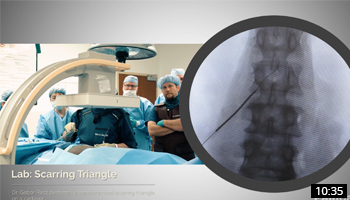
    Dr. Gabor Racz demonstrates the S1-scarring triangle technique during a cadaver course. He gives detailed information on direction and depth of the needle for precise catheter advancement. He is takes the time to explain every aspect of the procedure with the use of fluoroscopic imaging. He also discusses the volumes of injectants, and how the resistance felt while injecting is different than that of a lysis procedure and why.[/vc_column_text][/vc_column][vc_column width=”1/4″][vc_column_text]

    [/vc_column_text][/vc_column][/vc_row]

  • Scarring Triangle with Patient Interview

    Scarring Triangle with Patient Interview

    [vc_row css=”.vc_custom_1517944641032{padding-right: 20px !important;padding-left: 20px !important;background-color: #fbfbfb !important;}”][vc_column width=”3/4″][vc_column_text]

    Scarring Triangle with Interview
    Dr. Gabor B. Racz

    Published on May 31, 2017
    Dr. Gabor Racz evaluates a patient for back and left leg pain, which includes L4-L5 and L5-S1 muscle testing. As a result of the patient’s symptoms and the objective findings, Dr. Racz performs a “Scarring Triangle” procedure followed by a caudal lysis (to target the L-4 nerve root). These are both performed with the guidance of fluoroscopy. He explains the importance of adding a bend to the stylet for precise guidance. He also briefly mentions the injectants and volumes he uses for these procedures.[/vc_column_text][/vc_column][vc_column width=”1/4″][vc_column_text]

    [/vc_column_text][/vc_column][/vc_row]

  • Percutaneous Epidural Lysis of Adhesions Presentation

    Percutaneous Epidural Lysis of Adhesions Presentation

    [vc_row css=”.vc_custom_1517939115140{padding-right: 20px !important;padding-left: 20px !important;background-color: #fbfbfb !important;}”][vc_column][vc_column_text]Published on March 29, 2017

    Dr. Racz gives a comprehensive slide presentation at the 21st Annual International Pain Conference on his efforts, along with others, in discovering, understanding, and treating the area of the sacrum he has coined “The Scarring Triangle.” He gives a brief history of its discovery, and details the anatomy, pathology, and the revolutionary treatment of this area.

    [/vc_column_text][/vc_column][/vc_row]

  • Scarring Triangle

    Scarring Triangle

    [vc_row css=”.vc_custom_1517947260393{padding-right: 20px !important;padding-left: 20px !important;background-color: #fbfbfb !important;}”][vc_column width=”3/4″][vc_column_text]

    Published on February 15, 2017
    Dr. Racz performs a “Scarring Triangle” procedure. Under fluoroscopy, he explains how the pattern of contrast run-off can be used as an indicator of the scarring location and severity. He immediately follows with an L-4 transforaminal lysis. He explains his “direction-depth-direction” principle while advancing the needle and demonstrates how to angle the C-arm to properly identify the osseous structures to ensure a safe, transforaminal entry.[/vc_column_text][/vc_column][vc_column width=”1/4″][vc_column_text]

    [/vc_column_text][/vc_column][/vc_row]

  • The Scarring Triangle

    The Scarring Triangle

    [vc_row css=”.vc_custom_1517939115140{padding-right: 20px !important;padding-left: 20px !important;background-color: #fbfbfb !important;}”][vc_column][vc_column_text]Published on December 27, 2016

    Dr. Racz explains, in detail, how he and others discovered an area of the upper sacrum that he has coined the “Scarring Triangle.” He explains the importance of accessing this area to address the dense scarring that can build up and directly effect the L5-S1 nerve roots. He discusses how all other treatments usually fail to access this small cavity due to the structural challenges of the sacrum and surrounding anatomy. He demonstrates his technique while explaining the injectates and volumes he uses, as well as discussing the latest research findings that supports the use of these medications. He also talks about some of his patients he has treated with great success by this revolutionary technique.

    [/vc_column_text][/vc_column][/vc_row]

  • Trans-S1 Infralaminar “Scarring Triangle” Injectates

    Trans-S1 Infralaminar “Scarring Triangle” Injectates

    [vc_row css=”.vc_custom_1517939115140{padding-right: 20px !important;padding-left: 20px !important;background-color: #fbfbfb !important;}”][vc_column][vc_column_text]Published on March 25, 2015

    Dr. Gabor Racz reviews the injectates and volumes for the trans-S1 infralaminar “Scarring Triangle” technique during the procedure.

    [/vc_column_text][/vc_column][/vc_row][vc_row][vc_column][vc_column_text css=”.vc_custom_1488298613118{margin-top: -20px !important;}”]


    [/vc_column_text][/vc_column][/vc_row]
  • Trans-S1 Infralaminar “Scarring Triangle” Technique

    Trans-S1 Infralaminar “Scarring Triangle” Technique

    [vc_row css=”.vc_custom_1517939115140{padding-right: 20px !important;padding-left: 20px !important;background-color: #fbfbfb !important;}”][vc_column][vc_column_text]Published on March 23, 2015

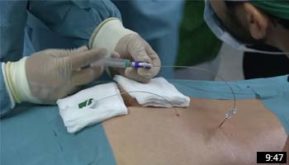
    Dr. Gabor Racz performs the trans-S1 infralaminar “Scarring Triangle” technique using an 18g RX-2 Coudé® needle and a VERSA-KATH.®

    [/vc_column_text][/vc_column][/vc_row]