Tag: radiculopathy

  • Epidural Adhesiolysis Lecture

    Epidural Adhesiolysis Lecture

    [vc_row css=”.vc_custom_1517939115140{padding-right: 20px !important;padding-left: 20px !important;background-color: #fbfbfb !important;}”][vc_column][vc_column_text]Published on October 29, 2020

    Does evidence show that neurolysis is effective? In this lecture, Ludger Gerdesmeyer, MD, PhD, FIPP, presents results from a clinical trial that showcase the potential benefits of epidural adhesiolysis. He also advocates for the use of evidence-based medicine, discusses his surprising placebo results, and explains the biases and flaws of past trial designs that tried to answer this question. This lecture was filmed at the 24th Annual Gabor Racz Pain Conference and Workshop.

    [/vc_column_text][/vc_column][/vc_row][vc_row][vc_column][vc_column_text css=”.vc_custom_1488298613118{margin-top: -20px !important;}”]


    [/vc_column_text][/vc_column][/vc_row]
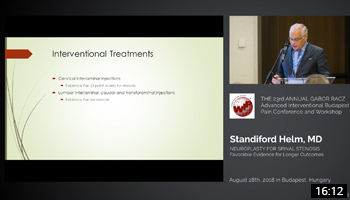
  • Neuroplasty for Spinal Stenosis

    Neuroplasty for Spinal Stenosis

    [vc_row css=”.vc_custom_1517939115140{padding-right: 20px !important;padding-left: 20px !important;background-color: #fbfbfb !important;}”][vc_column][vc_column_text]Published on February 7, 2020
    Dr. Standiford Helm provides a detailed presentation on the efficacy of adhesiolysis for revealing pain form spinal stenosis. He explains the pathology of stenosis, the mechanism of action of adhesiolysis, and the many pathologies for which this is effective. Using current research, Dr. Helm explains how this procedure mitigates epidural scarring and reduces inflammation. [/vc_column_text][/vc_column][/vc_row][vc_row][vc_column][vc_column_text css=”.vc_custom_1488298613118{margin-top: -20px !important;}”]


    [/vc_column_text][/vc_column][/vc_row]

  • Flexion-Rotation with the RX-2

    Flexion-Rotation with the RX-2

    [vc_row css=”.vc_custom_1517939115140{padding-right: 20px !important;padding-left: 20px !important;background-color: #fbfbfb !important;}”][vc_column][vc_column_text]Published on November 4, 2016

    By using the Blunt RX Needle in the cervical spine, the patient is free to perform flexion with rotation motions without the risk of puncturing the dura and other structures. This cervical rotation facilitates movement of the injectate over the nerve roots, drastically improving the procedure’s efficacy.

    [/vc_column_text][/vc_column][/vc_row]