Tag: failed back surgery syndrome

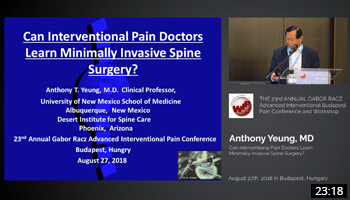
  • Minimally Invasive Spine Surgery

    Minimally Invasive Spine Surgery

    [vc_row css=”.vc_custom_1517939115140{padding-right: 20px !important;padding-left: 20px !important;background-color: #fbfbfb !important;}”][vc_column][vc_column_text]Published on April 29, 2020

    Dr. Anthony Yeung discusses the need for quality training of pain physicians who perform spinal surgery. He also talks about the different innate mindsets of physicians and surgeons, and why it is imperative to keep egos in check when working together to alleviate patients’ pain. Dr. Yeung highlights the clinical reasons for Failed Back Surgery Syndrome (FBSS) and why endoscopic surgery is a less invasive alternative with higher success rates. He concludes his presentation by reinforcing the need for all physicians to practice evidence based medicine.

    [/vc_column_text][/vc_column][/vc_row][vc_row][vc_column][vc_column_text css=”.vc_custom_1488298613118{margin-top: -20px !important;}”]


    [/vc_column_text][/vc_column][/vc_row]
  • Evidence of Neuromodulation

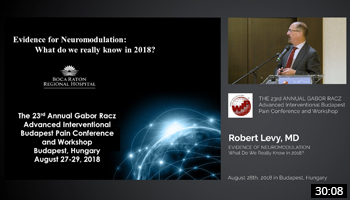
    Evidence of Neuromodulation

    [vc_row css=”.vc_custom_1517939115140{padding-right: 20px !important;padding-left: 20px !important;background-color: #fbfbfb !important;}”][vc_column][vc_column_text]Published on November 14, 2019

    Dr. Robert Levy discusses the science of neuromodulation and its efficacy from numerous studies. He compares the mechanism of action of tonic, high frequency, and burst stimulation. Dr. Levy reveals, via current literature, that DRG stimulation has the most therapeutic effect and explains why. He concludes with promising data on new wave-forms being studied.

    [/vc_column_text][/vc_column][/vc_row][vc_row][vc_column][vc_column_text css=”.vc_custom_1488298613118{margin-top: -20px !important;}”]


    [/vc_column_text][/vc_column][/vc_row]
  • Challenges in the Management of Chronic Low Back Pain

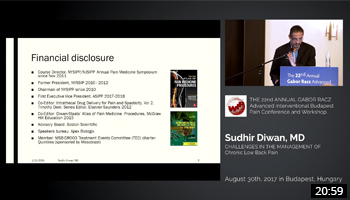
    Challenges in the Management of Chronic Low Back Pain

    [vc_row css=”.vc_custom_1517939372672{padding-right: 20px !important;padding-left: 20px !important;background-color: #fbfbfb !important;}”][vc_column width=”3/4″][vc_column_text]Published on June 18, 2018
    Dr. Sudhir Diwan discusses the ongoing struggle in which physicians have in properly diagnosing low back pain. He goes over several statistics showing the true disconnect with diagnoses and true cause of low back pain. He explains the pathophysiology of degenerative disc disease (DDD) and related discogenic pain. He also discusses facet and SI pain and treatments.[/vc_column_text][/vc_column][vc_column width=”1/4″][vc_column_text]

    [/vc_column_text][/vc_column][/vc_row]
  • Surgical Options to Treat Low Back Pain

    Surgical Options to Treat Low Back Pain

    [vc_row css=”.vc_custom_1517939115140{padding-right: 20px !important;padding-left: 20px !important;background-color: #fbfbfb !important;}”][vc_column][vc_column_text]Published on May 3, 2018

    Dr. Lorand Eross describes several surgical options currently used to treat low back pain, including fusions and discectomies. He explains the advantages and disadvantages for these procedures, as well as why some are ineffective. His introduction consists of detailed statistics on low back pain and its epidemiology, and concludes with discussion of literature on the subject.

    [/vc_column_text][/vc_column][/vc_row]

  • Failed neck surgery

    Failed neck surgery

    [vc_row css=”.vc_custom_1517939115140{padding-right: 20px !important;padding-left: 20px !important;background-color: #fbfbfb !important;}”][vc_column][vc_column_text]Published on April 14, 2017

    Dr. Racz gives a slide presentation at the 21st Annual International Pain Conference on new discoveries concerning the diagnosis and treatment of fail neck surgery. He details cases in which invasive procedures to treat cervical stenosis fail and worsen the condition. He also emphasizes the importance of the cervical venous anatomy, as it differs from the thoracic spine. He then details the mechanics of cervical flexion-rotation, and its effects on the neural foramen and involved nerve root. Dr. Racz reinforces this information with literature, MRI, and x-ray images.

    [/vc_column_text][/vc_column][/vc_row][vc_row][vc_column][vc_column_text css=”.vc_custom_1488298613118{margin-top: -20px !important;}”]


    [/vc_column_text][/vc_column][/vc_row]