Tag: DRG

  • Chapman – Dorsal Root Ganglion Stimulation for Low Back Pain

    Chapman – Dorsal Root Ganglion Stimulation for Low Back Pain

    [vc_row css=”.vc_custom_1517939115140{padding-right: 20px !important;padding-left: 20px !important;background-color: #fbfbfb !important;}”][vc_column][vc_column_text]Published on November 17, 2021

    Dr. Kenneth B. Chapman discusses dorsal root ganglion (DRG) stimulation for low back pain. Dr. Chapman describes the results of his clinical research on this topic. This DRG stimulation results in impressive improvements across several objective measures of quality of life and disability. The anatomy of the spinal nerve and spinal cord are also discussed.

    [/vc_column_text][/vc_column][/vc_row][vc_row][vc_column][vc_column_text css=”.vc_custom_1488298613118{margin-top: -20px !important;}”]


    [/vc_column_text][/vc_column][/vc_row]
  • Levy – Dorsal Root Ganglion Stimulation

    Levy – Dorsal Root Ganglion Stimulation

    [vc_row css=”.vc_custom_1517939115140{padding-right: 20px !important;padding-left: 20px !important;background-color: #fbfbfb !important;}”][vc_column][vc_column_text]Published on November 17, 2021

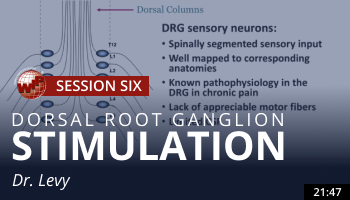
    Dr. Robert Levy discusses dorsal root ganglion stimulation. He talks about the anatomy of the dorsal root ganglion, including the types of neurons that make up this area and their roles. Much is known about the dorsal root ganglion, including its role in neuropathic pain. Dorsal root ganglion stimulation can be an effective option for pain management, even at long term time points. This type of stimulation may even be superior to spinal cord stimulation, at least for certain types of pain.

    [/vc_column_text][/vc_column][/vc_row][vc_row][vc_column][vc_column_text css=”.vc_custom_1488298613118{margin-top: -20px !important;}”]


    [/vc_column_text][/vc_column][/vc_row]
  • DRG and Chronic Pain

    DRG and Chronic Pain

    [vc_row css=”.vc_custom_1517939115140{padding-right: 20px !important;padding-left: 20px !important;background-color: #fbfbfb !important;}”][vc_column][vc_column_text]Published on October 11, 2021

    Dr. Alex D. Pham discusses the dorsal root ganglion (DRG) and chronic pain. Chronic neuropathic pain is widespread and difficult to treat. However, targeting the DRG has begun to show promising effects in pain alleviation. Dr. Pham and his colleagues conducted a systemic literature search and found several promising case reports that support the use of DRG stimulation. Overall, this developing technique may allow for a precise approach to chronic pain management.

    [/vc_column_text][/vc_column][/vc_row][vc_row][vc_column][vc_column_text css=”.vc_custom_1488298613118{margin-top: -20px !important;}”]


    [/vc_column_text][/vc_column][/vc_row]
  • The Challenges of DRG Stimulation

    The Challenges of DRG Stimulation

    [vc_row css=”.vc_custom_1517939115140{padding-right: 20px !important;padding-left: 20px !important;background-color: #fbfbfb !important;}”][vc_column][vc_column_text]Published on June 22, 2021

    Dr. Kenneth Chapman lectures on the many challenges posed by dorsal root ganglion (DRG) stimulation research and procedures. Dr. Chapman is excited about the recent research on blocking pain signals and the different stimulators that are used. He believes that stimulation therapy is one of the keys to improving patients’ lives.

    [/vc_column_text][/vc_column][/vc_row][vc_row][vc_column][vc_column_text css=”.vc_custom_1488298613118{margin-top: -20px !important;}”]


    [/vc_column_text][/vc_column][/vc_row]
  • Dorsal Root Ganglion Stimulation

    Dorsal Root Ganglion Stimulation

    [vc_row css=”.vc_custom_1517939115140{padding-right: 20px !important;padding-left: 20px !important;background-color: #fbfbfb !important;}”][vc_column][vc_column_text]Published on October 22, 2020

    Dr. Kort Gronbach discusses dorsal root ganglion (DRG) stimulation for treating pain. He first outlines the benefits of DRG stimulation, highlighting that DRG stimulation corresponds to anatomy much better than dorsal column stimulation. He then describes the implant procedure, including patient positioning, needle entry point and trajectory, epidural access, and DRG targeting. He concludes by describing case studies that influenced his current standard operating procedures.

    [/vc_column_text][/vc_column][/vc_row][vc_row][vc_column][vc_column_text css=”.vc_custom_1488298613118{margin-top: -20px !important;}”]


    [/vc_column_text][/vc_column][/vc_row]

  • New Targets in Neuromodulation

    New Targets in Neuromodulation

    [vc_row css=”.vc_custom_1517939115140{padding-right: 20px !important;padding-left: 20px !important;background-color: #fbfbfb !important;}”][vc_column][vc_column_text]Published on August 7, 2020

    Dr. Kenneth Chapman discusses new targets for neuromodulation in pain control protocols. After a brief description of recent device innovations, he elaborates on current data from studies on vagal nerve stimulation, sacral nerve root stimulation, and dorsal root ganglion (DRG) stimulation. Dr. Chapman then introduces some of his own work targeting the T12 DRG with low frequency stimulation in severe low back pain patients and concludes with a potential mechanism of action.

    [/vc_column_text][/vc_column][/vc_row][vc_row][vc_column][vc_column_text css=”.vc_custom_1488298613118{margin-top: -20px !important;}”]


    [/vc_column_text][/vc_column][/vc_row]

  • Advanced Techniques for RFA

    Advanced Techniques for RFA

    [vc_row css=”.vc_custom_1517939115140{padding-right: 20px !important;padding-left: 20px !important;background-color: #fbfbfb !important;}”][vc_column][vc_column_text]Published on July 30, 2020

    Dr. Corey Hunter discusses advanced techniques for radiofrequency ablation (RFA). After a brief review of RFA methods and targets, Dr. Hunter describes the mapping procedure used to identify nerves that are causing pain. He then turns to newer RFA targets, including the dorsal root ganglion, the genicular nerve, and the suprascapular nerve, among others. Dr. Hunter also describes the value of RFA of the sphenopalatine and Gasserian ganglia for people with facial pain.

    [/vc_column_text][/vc_column][/vc_row][vc_row][vc_column][vc_column_text css=”.vc_custom_1488298613118{margin-top: -20px !important;}”]


    [/vc_column_text][/vc_column][/vc_row]

  • Transgrade SCS Procedure

    Transgrade SCS Procedure

    [vc_row css=”.vc_custom_1517939115140{padding-right: 20px !important;padding-left: 20px !important;background-color: #fbfbfb !important;}”][vc_column][vc_column_text]Published on June 25, 2020

    This video procedure demonstrates placing dual 4-contact leads bilaterally at the T9 DRG using a transgrade approach. This technique differs from paramedian or transforaminal DRG approach. Dr. Billet walks you through the technique to treat chronic low back pain at the DRG.

    [/vc_column_text][/vc_column][/vc_row][vc_row][vc_column][vc_column_text css=”.vc_custom_1488298613118{margin-top: -20px !important;}”]


    [/vc_column_text][/vc_column][/vc_row]
  • ASPN Webinar: DRG Stimulation, the Science, Technique and Data

    ASPN Webinar: DRG Stimulation, the Science, Technique and Data

    [vc_row css=”.vc_custom_1517939115140{padding-right: 20px !important;padding-left: 20px !important;background-color: #fbfbfb !important;}”][vc_column][vc_column_text]Published on June 23, 2020

    Hosted by Tim Deer, MD, and Krishna Chakravarthy, MD, the purpose of this webinar is to learn the science behind DRG stimulation for the relief of chronic pain and other conditions. Participants will learn best practices and techniques and participate in discussions surrounding the Clinical Data supporting the DRG Stimulation.

    [/vc_column_text][/vc_column][/vc_row][vc_row][vc_column][vc_column_text css=”.vc_custom_1488298613118{margin-top: -20px !important;}”]


    [/vc_column_text][/vc_column][/vc_row]
  • DRG Neuromodulation: Literature Update and Best Practices

    DRG Neuromodulation: Literature Update and Best Practices

    [vc_row css=”.vc_custom_1517939115140{padding-right: 20px !important;padding-left: 20px !important;background-color: #fbfbfb !important;}”][vc_column][vc_column_text]Published on June 5, 2020

    Dr. Michael Esposito provides a literature update and an overview of best practices for dorsal root ganglion (DRG) stimulation. He begins with a review of DRG anatomy and identifies characteristics that make it an ideal target for neuromodulation. Dr. Esposito then outlines the results of several large studies that demonstrate the safety and efficacy of DRG stimulation. He concludes by presenting case reports and predicts future directions, including neuroimmune modulation.

    [/vc_column_text][/vc_column][/vc_row][vc_row][vc_column][vc_column_text css=”.vc_custom_1488298613118{margin-top: -20px !important;}”]


    [/vc_column_text][/vc_column][/vc_row]