
Tag: Degenerative Disc Disease

  • Cervical Canal Space

    Cervical Canal Space

    [vc_row css=”.vc_custom_1517939115140{padding-right: 20px !important;padding-left: 20px !important;background-color: #fbfbfb !important;}”][vc_column][vc_column_text]Published on March 22, 2022

    Brian K. Flanagan, MD, discusses the importance of ensuring there is enough space in the cervical canal. Patients with herniated discs, spinal stenosis and degenerative disc disease all have narrow cervical spaces which decreases safety margins. Dr. Flanagan also discusses a patient story of cord compression after injecting into the cervical space. He highlights the importance of taking x-ray images to determine the canal diameter before performing any procedures.

    [/vc_column_text][/vc_column][/vc_row][vc_row][vc_column][vc_column_text css=”.vc_custom_1488298613118{margin-top: -20px !important;}”]


    [/vc_column_text][/vc_column][/vc_row]

  • Percutaneous Discectomy

    Percutaneous Discectomy

    [vc_row css=”.vc_custom_1517939115140{padding-right: 20px !important;padding-left: 20px !important;background-color: #fbfbfb !important;}”][vc_column][vc_column_text]Published on October 14, 2020

    In this lecture, Dr. Sudhir Diwan discusses disc health and disease. He shares his perspective on what direction the field is moving in, describes tools and techniques used during disc procedures, and summarizes the relevant literature. Dr. Diwan also describes the indications and advantages of percutaneous discectomy and compares it to similar techniques. This lecture was filmed at the 24th Annual Gabor Racz Pain Conference and Workshop in Budapest, Hungary.

    [/vc_column_text][/vc_column][/vc_row][vc_row][vc_column][vc_column_text css=”.vc_custom_1488298613118{margin-top: -20px !important;}”]


    [/vc_column_text][/vc_column][/vc_row]
  • Stem Cell Augmentation and Degenerative Disc Disease

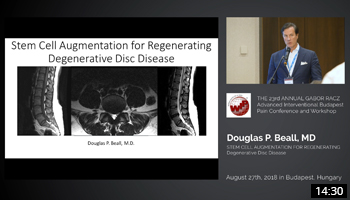
    Stem Cell Augmentation and Degenerative Disc Disease

    [vc_row css=”.vc_custom_1517939115140{padding-right: 20px !important;padding-left: 20px !important;background-color: #fbfbfb !important;}”][vc_column][vc_column_text]Published on July 9, 2019

    Dr. Douglas Beall explains the use of mesoblastic progenitor cells (MPC) to treat degenerative disc disease. He explains how MPCs are processed and injected into the disc and discusses the results for a phase II trial that used these MPCs for pain reduction and improved function for up to three years. He also discusses the successful VAST trial and the complex biochemical assays that were used.

    [/vc_column_text][/vc_column][/vc_row][vc_row][vc_column][vc_column_text css=”.vc_custom_1488298613118{margin-top: -20px !important;}”]


    [/vc_column_text][/vc_column][/vc_row]

  • Concepts and Diagnosis of Discogenic Pain

    Concepts and Diagnosis of Discogenic Pain

    [vc_row css=”.vc_custom_1517939115140{padding-right: 20px !important;padding-left: 20px !important;background-color: #fbfbfb !important;}”][vc_column][vc_column_text]Published on November 2, 2018

    Dr. Andre Mansano gives a slide presentation on discogenic pain that begins with a brief anatomical review of the disc and mechanisms of degenerative disc disease (DDD). After reviewing several studies, he discusses how there is no absolute standard to diagnose DDD. Dr. Mansano then explains how to perform a provocative discography using fluoroscopic views. He explains the importance of measuring the pressure of the injection and how a discoblock can be an alternative to diagnose DDD.

    [/vc_column_text][/vc_column][/vc_row]
  • Role of the Dorsal Root Ganglion in Neuropathic Pain

    Role of the Dorsal Root Ganglion in Neuropathic Pain

    [vc_row css=”.vc_custom_1517939115140{padding-right: 20px !important;padding-left: 20px !important;background-color: #fbfbfb !important;}”][vc_column][vc_column_text]Published on October 17, 2018

    Prof. Marshall Devor gives an informative lecture on the nature of neuropathic pain, and how it differs in both physiology and treatment from nociceptive pain. He presents compelling evidence that shows that neuropathic pain is mostly generated by the cells within the DRG and not from axonal injury. He discusses a surprising alternative to the widely accepted cause of radiculopathy (sciatica in this case) that physician encounter on a daily basis.

    [/vc_column_text][/vc_column][/vc_row]
  • Challenges in the Management of Chronic Low Back Pain

    Challenges in the Management of Chronic Low Back Pain

    [vc_row css=”.vc_custom_1517939372672{padding-right: 20px !important;padding-left: 20px !important;background-color: #fbfbfb !important;}”][vc_column width=”3/4″][vc_column_text]Published on June 18, 2018
    Dr. Sudhir Diwan discusses the ongoing struggle in which physicians have in properly diagnosing low back pain. He goes over several statistics showing the true disconnect with diagnoses and true cause of low back pain. He explains the pathophysiology of degenerative disc disease (DDD) and related discogenic pain. He also discusses facet and SI pain and treatments.[/vc_column_text][/vc_column][vc_column width=”1/4″][vc_column_text]

    [/vc_column_text][/vc_column][/vc_row]
  • Degenerative Disc Disease And Biological Treatment Of The Spine

    Degenerative Disc Disease And Biological Treatment Of The Spine

    [vc_row css=”.vc_custom_1517939115140{padding-right: 20px !important;padding-left: 20px !important;background-color: #fbfbfb !important;}”][vc_column][vc_column_text]Published on December 6, 2017

    Dr. Aaron Calodney gives an interesting presentation describing the implications of regenerative treatments for discogenic pain and degenerative disc disease. He explains the differences between these disc pathologies as well as their etiologies. This leads into his discussion of how regenerative medicine has shown progress in treating both of these disc pathologies.

    [/vc_column_text][/vc_column][/vc_row]